CHUKRASIA TABULARIS A. Juss.
| Division |
Angiosperms |
 |
| Class |
Dicotledons |
| Subclass |
Polypetalae |
| Series |
Disciflorae |
| Order |
Geraniales |
| Family |
Meliaceae |
| Genus |
Chukrasia |
| Species |
tabularis |
| Etymology |
The name is derived from Hindi name of the tree, Chukrasi – “Chickrassy wood” of commerce. |
| Botanical name: |
Chukrasia tabularis A. Juss. (C. velutina Wight. & Ann.). |
| Local/Trade Names: |
Chittagong Wood, Chikrassi, Chukrasia, Bastard Cedar, East Indian Mahogany |
| Conservation status |
Commonly planted as avenue tree. |
| Digonestic features |
Bark dark brown; blaze exfoliating into pink. |
| Description: |
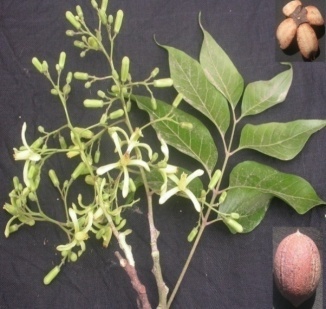
A large tree, usually deciduous. Bark dark brown; blaze exfoliating into pink coloured papery rolls. Leaves pinnately compound; leaflets 10-24, unequal-sided, 5-10 cm long, ovate or elliptic-lanceolate, slightly hairy beneath. Flowers white or pale-yellowish, ca 1 cm across. Fruit a capsule, ovoid, 2.5-3 cm long, 3-valved, woody. Seeds numerous, winged. |
| Phenology |
Fls.: During hot and rainy season. Frts.: Nov.-Dec. It sheds leaves during the winter. |
| Distribution |
India, Bangladesh and Mayanmar. |
| Where to see it |
Gate no. 2 side. |
| Uses |
Wood is lustrous possessing an attractive mahogany-like figure. Used for high class furniture, paneling and decorative work; also for plywood, laminated boards, canoes and cooperage. Young leaves and bark contain 22% and 15% tannin respectively. Tree exudes a water soluble reddish or amber coloured gum. |