| Etymology: |
Derived from Greek word ‘pithekos’, ape, and ‘lobas’, lobe; in allusion to the native name signifying Monkey’s ear. |
| Botanical name: |
Pithecellobium dulce (Roxb.) Benth. (Inga dulcis (Roxb.) Willd.) |
| Local/Trade Names: |
Jangal Jalebi, Quamachil, Madras Thorn, Manila Tamarind |
| Conservation status: |
Commonly planted as a hedge. |
| Digonestic features: |
Pods turgid with pink or white pulpy edible aril. |
| Description: |
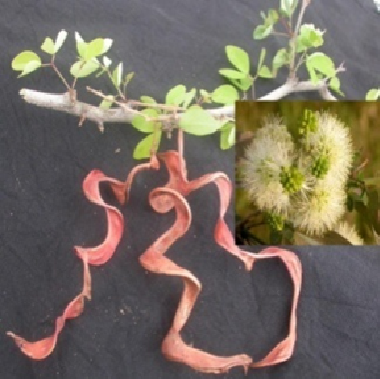
A medium-sized evergreen tree. Leaf stipulate, modified into spine; rachis 1-2.5 cm long; pinnae one pairs; leaflets two on each pinna, elliptic-oblong, oblique, 2-4.5 cm long. Flowers greenish-white, in small globose peduncled heads, arranged in long panicled racemes. Pods 10-13 cm x 2-3 mm, turgid. Seeds 5-9, enveloped in pink or white pulpy edible aril. |
| Phenology: |
Fls. & Frts.: October-April. |
| Distribution: |
Native of Mexico. |
| Where to see it: |
Near Energy Park and Medicinal Plant Garden. |
| Uses: |
Very suitable for hedges and as fuel as it has fast rate of growth, coppices vigorously and can stand any amount of pruning, lopping, and browsing. Pods used as fodder. Seeds eaten raw, or in curries. Saline extract of seeds shows a hemolytic agglutinating reaction with human blood. Yield a fatty oil used for edible purposes and for soap manufacture; may also be used as a substitute for kapok seed and ground nut oils. Meal has a high protein content (29.7%) and may be used as an animal feed. Bark contains tannin. Leaves serve as fodder. Wood used for general construction. |