|
Division |
Angiosperms |
|
|
Class |
Dicotledons |
|
|
Subclass |
Polypetalae |
|
|
Series |
Disciflorae |
|
|
Order |
Geraniales |
|
|
Family |
Simarubaceae |
|
|
Genus |
Ailanthus |
|
|
Species |
excelsa
|
|
|
|
|
|
|
Etymology: |
Ailanto is the local name used in Moluccas, meaning sky tree, commonly known as Tree of Heaven. |
|
Botanical name: |
Ailanthus excelsa Roxb. |
|
Local/Trade names: |
Maharukh, Tree of Heaven, Coromandel Ailanto, Ardu, Arua, Ulloo |
|
Conservation status: |
Commonly planted. |
|
Digonestic features: |
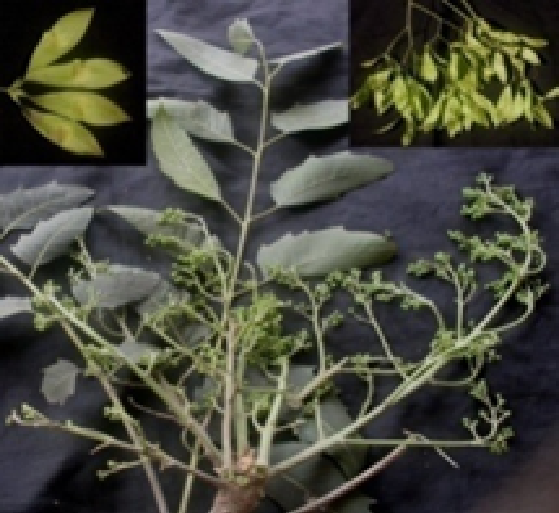
Leaves odd pinnate, unequal at base; fruit a samara. |
|
Description: |
Tall tree, upto 15-20 m high. Bark whitish; branchlets with persisent leaf scars. Leaves odd pinnate 30 x 15 cm; leaflets 8-14 pairs, oblong lanceolate, unequal at base, margin irregularly toothed. Flowers in panicles axillary or terminal. Fruit a samara, linear, oblong to lanceolate, 2.5 x 1 cm, prominently nerved one seeded. |
|
Phenology: |
Fls.: Feb.-March. Frts.: May-June. |
|
Distribution: |
Bihar, Central Provinces, Gujarat, Deccan and Andhra Pradesh. |
|
Where to see it: |
Gate No. 2 side. |
|
Uses: |
Wood used for catamarans and small boats; also used for veneers and plywood packing-cases, sword-handles, toys, and poor quality matches. Bark anthelmintic, febrifuge, expectorant and antispasmodic used for asthma and bronchitis, also for dysentery; said to be good substitude for kurchi bark ( Holarrhena pubescens)contains several quassinoides. Root bark yields alkaloids. Trees yield inferior quality Bassora or Hog gum and serves as a host for ‘Eri’ silkworms. Leaves and shoots used as fodder |