| Etymology: |
Pongam is a Tamil and Malayalam name for Pongamia pinnata. |
| Botanical name: |
Pongamia pinnata (Linn.) Merr. ( P. glabra Vent., Derris indica (Lam.) Bennet) |
| Local/Trade Names: |
Karanja, Indian Beech, Pilagaria |
| Conservation status: |
Commonly planted on roadsides and gardens. |
| Digonestic features: |
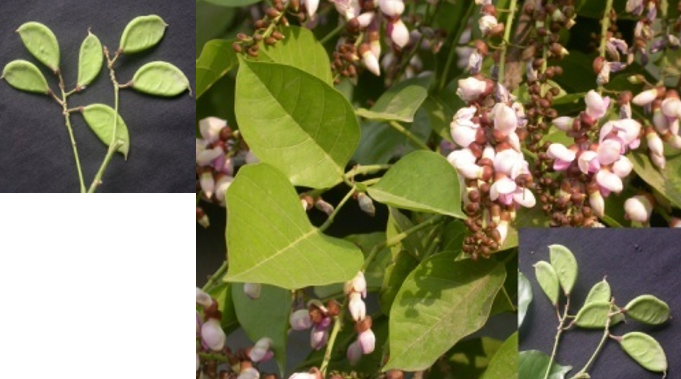
Flowers white or purple; pods flat, woody. |
| Description: |
A small tree. Bark grey. Leaves 15-25 cm long, imparipinnate; leaflets ovate-elliptic, acuminate, obtuse at base, dark green above, pale beneath. Flowers white or purple, 2-4-nate in simple axillary, peduncled racemes on short pedicels. Pod woody, flattened, oblong, indehiscent. Seeds 1-2. |
| Phenology: |
Fls.: May-June. Frts.: December-April. |
| Distribution: |
Throughout the India, Andaman and Nicobar Island. |
| Where to see it: |
Near Energy Park and Medicinal Plant Garden. |
| Uses: |
Seeds yield a fatty oil, Pongam Oil, used in tanning industry for dressing E.I. leathers; it also finds use in the preaparation of washing soaps and candles, and as a lubricant for heavy lathes, chains, enclosed gears and heavy engines, and bearings of small gas engines; medicinally it is applied in scabies, herpes, leucoderma, and other cutaneous diseases; internally it is used in dyspepsia with sluggish liver. Karanjin is the active principle. Seed cakes used as manure. Wood used for yokes of bullock carts, ploughs, cart-wheels, rafters, thatched cottages, oil mills, furniture, and small turnery articles. Its use as pattern wood and for veneering has also been suggested. Leaves lopped for fodder, act as a galactagogue. Juice of leaves prescribed in flatulence, dyspepsia, diarrhoea, and cough; also used in leprosy and gonorrhea. Juice of roots used for cleansing foul ulcers and fistulous sores and for cleaning teeth and strengthening gums. Roots and leaves used as fish-poison. Bark yields fibre, used a for cordage. Fresh bark given for piles. |